The Heritage · The Mother Church
A century of apostolic faith under Black authority.
From Garvey’s Chaplain-General to a surviving thread of displaced Overtown — the lineage of the Mother Church.
SECTION I — The Founding
Born of self-determination in the Garvey line.
His founding purpose was not separation from the catholic faith but freedom within it. “We are Catholic in theology,” he taught, “independent for Black churches so that we would not necessarily have to be under the authority of any white body.” The African Orthodox Church carried Anglican-derived liturgical texts with Western, Tridentine-style ceremonial and Western vestments — Catholic in theology, Orthodox in succession, African in inheritance.

George Alexander McGuire, founder and first Patriarch of the African Orthodox Church, in the year of its founding, 1921 — vested in the apostolic succession he had secured for a Black-led church.

Marcus Garvey, 1924. McGuire served as Chaplain-General of Garvey’s Universal Negro Improvement Association — the movement that called the African Orthodox Church into being.
SECTION II — The Journey South
Twelve laymen, one priest, and the heart of Black Miami.
The mission reached the South through West Palm Beach in nineteen twenty-five. Miami’s parish began when twelve laymen petitioned McGuire for a priest, and the Reverend Ernest Leopold Petersen was sent from New York to serve them. He arrived to a congregation with no building of its own and a city whose Black life was centered in Overtown — the neighborhood that would be called the Harlem of the South.
Overtown was the heart of Black Miami: hotels, theaters, restaurants, churches, and nightclubs along Second Avenue, where Cab Calloway and Billie Holiday played after downtown sets they could not attend. The parish made its first home there, among the people it served. The AOC ran two seminaries, including the George Alexander McGuire Theological Institute in Miami, training Black clergy for Black churches across the jurisdiction.

Overtown today — the neighborhood where the parish was born. The Harlem of the South, before the highway and urban renewal scattered it.

A Black congregation’s church in Homestead, Florida, 1939 — the world of worship South Florida’s Black communities built in the parish’s early era.

Main street of the Black section of Homestead, Florida, January 1939 — the civic life that surrounded the churches of South Florida’s Black communities in the parish’s early era.
The AOC reaches the South through West Palm Beach — the first foothold in Florida.
Twelve Miami laymen petition McGuire for a priest. The Rev. Ernest Leopold Petersen is sent from New York.
The parish is born in the heart of Black Miami — the Harlem of the South.
SECTION III — 1968 The Displacement
Urban renewal scattered Black Overtown. The congregation carried its church.
In the decades that followed, the federal highway program and Miami’s urban renewal tore through Black Overtown. Interstate 95 was driven through the neighborhood’s center; thousands of homes and businesses were demolished; the congregation was displaced. In nineteen sixty-eight, the people carried their church northwest to its present house at 4841 NW 2nd Avenue and incorporated as the Cathedral — the Mother Church of the African Orthodox Church. The building was raised in nineteen fifty-two; the sanctuary was renovated in nineteen eighty-eight.
What stands today is a surviving thread of displaced Overtown — a congregation that kept its liturgy and its lineage through the destruction of its first home. The old Overtown building at 1811 NW 4th Court, which the parish once knew, now belongs to another communion; the Mother Church makes no claim on it. The cathedral’s story is the one it lived: Overtown, the scattering, the present house.
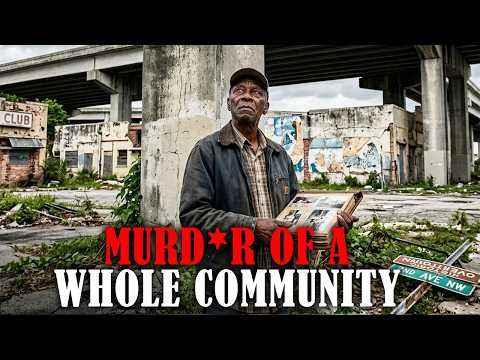
The urban-renewal displacement that scattered Black Overtown — and the congregation that carried its church to 4841 NW 2nd Avenue.